
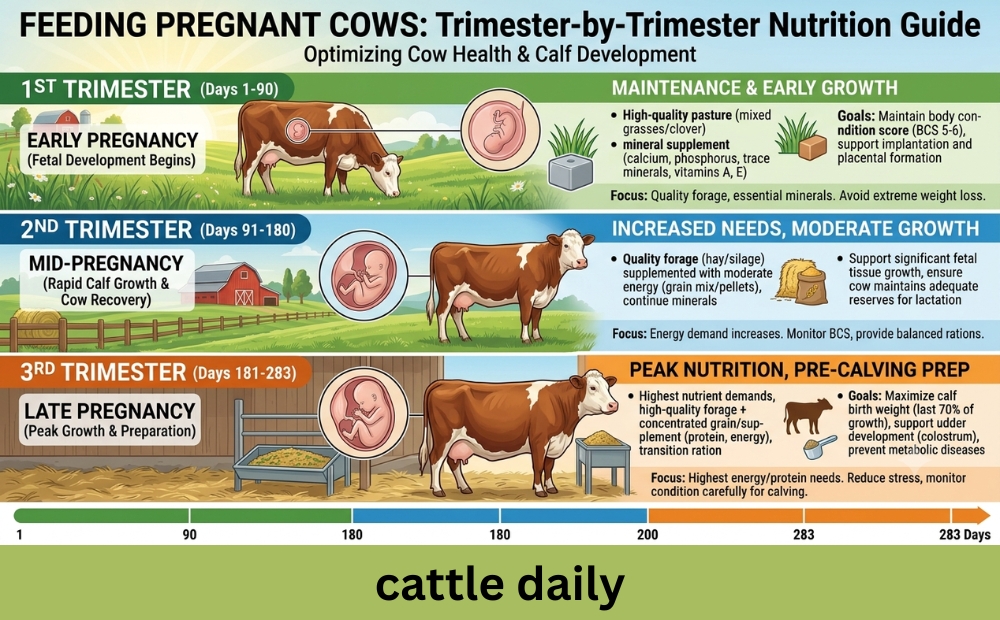
Feeding Pregnant Cows: Trimester-by-Trimester Nutrition Guide 2026
By CattleDaily.com | Beef & Cow-Calf Management | ~2,000 Words | Expert-Reviewed
📋 Quick Summary
Proper nutrition during pregnancy is the single most impactful management decision a cattleman can make — directly affecting calf birth weight, cow rebreeding efficiency, colostrum quality, and long-term calf performance. This comprehensive 2026 guide breaks down exactly what your pregnant cows need during each of the three trimesters, from conception to calving. You'll find specific energy, protein, mineral, and vitamin targets supported by the latest research, practical ration examples, and common nutritional mistakes to avoid. Whether you manage a small cow-calf herd or a large commercial beef operation, this trimester-by-trimester framework gives you the tools to raise healthier calves and more productive cows every single year.
1. Why Cow Nutrition During Pregnancy Matters
The nutritional status of a pregnant cow isn't just about her own health — it sets the biological foundation for everything her calf will become. Research into fetal programming (also called the developmental origins of health and disease) confirms that nutrient restriction during gestation can suppress calf immune function, reduce muscle fiber development, impair reproductive capacity in heifer calves, and lower average daily gain post-weaning — all without obvious signs at birth.
For commercial cow-calf producers, the economic implications are significant. Studies from the University of Nebraska and South Dakota State University have consistently shown that cows underfed during the third trimester produce calves with lower weaning weights, weaker immune responses, and reduced lifetime productivity. Conversely, cows that enter calving at an ideal body condition score (BCS 5–6) rebreed faster and wean heavier calves — compounding profitability across multiple production cycles.
Energy (TDN/NEm)
Fuels fetal growth, maintains body reserves, and supports milk production
Protein (CP/RUP)
Critical for fetal muscle development, placental function, and colostrum quality
Minerals
Selenium, copper, zinc, and iodine directly impact calf vigor and immunity
Vitamins A, D & E
Support immune function, bone development, and antioxidant protection
2. Gestation Overview & Trimester Framework
A cow's gestation period averages 283 days (~9.5 months). For management purposes, this is divided into three trimesters of approximately 3 months each. Each trimester has distinct physiological demands, and the nutritional strategy must evolve accordingly.
Embryo Establishment
- Embryo implantation
- Organ development begins
- Low fetal nutrient demand
- Focus on body condition
- Recovery from calving & lactation
Fetal Development
- Muscle fiber formation
- Skeletal system develops
- Moderate nutrient demand
- Placental growth peaks
- Maintain BCS 5–5.5
Rapid Fetal Growth
- 75% of fetal growth occurs
- Colostrum development
- High nutrient demand
- Critical for calf vigor
- Target BCS 5.5–6
📊 Relative Nutritional Demand by Stage of Pregnancy (% of Maintenance)
*Values based on a 1,200 lb mature beef cow. Actual requirements vary by cow size, breed, climate, and body condition.
3. First Trimester Nutrition (Months 1–3)
The first trimester is the most commonly under-managed period in cow nutrition — largely because cows are simultaneously nursing calves, facing rebreeding pressures, and grazing summer pastures. Paradoxically, this stage carries enormous importance because the critical window of early embryonic development occurs here, and conception rates are directly tied to cow nutritional status at breeding.
Key Priorities in the First Trimester
Body condition recovery is the dominant goal. Cows that calved at BCS 4 or lower face significantly reduced conception rates. The window between calving and rebreeding (50–80 days) is where nutritional investment pays the most dividends. Feeding a total mixed ration (TMR) approach during this phase can be highly effective at efficiently balancing energy, protein, and mineral needs from diverse feedstuffs.
| Nutrient | Requirement (1,200 lb cow) | Primary Feed Sources | Consequence of Deficiency |
|---|---|---|---|
| Energy (TDN) | 11–13 lbs/day | Pasture, hay, silage | Low BCS, embryo loss |
| Crude Protein | 1.8–2.0 lbs/day (~10–11%) | Legume hay, DDGs, cake | Reduced conception rates |
| Calcium | 26 g/day | Legume hay, mineral mix | Skeletal issues |
| Phosphorus | 18 g/day | Mineral supplement | Impaired reproduction |
| Vitamin A | 30,000–40,000 IU/day | Green forage, supplement | Embryonic death |
4. Second Trimester Nutrition (Months 4–6)
The second trimester represents a nutritional "grace period" of sorts — the fetus grows steadily but not rapidly, and dry matter intakes are generally sufficient from quality forage to meet demands. However, this is the most critical window for fetal muscle fiber development. Research confirms that the total number of muscle fibers a calf will ever possess is determined by mid-gestation. More muscle fibers = more potential for growth and carcass quality.
Protein Quality Matters — Not Just Quantity
During the second trimester, bypass protein (rumen-undegradable protein, or RUP) becomes increasingly important. The developing fetus requires a steady supply of amino acids that reach the small intestine without being degraded in the rumen. Feedstuffs like distillers grains, blood meal, and fish meal offer high RUP fractions that can enhance fetal muscle development beyond what crude protein alone indicates. Understanding how cattle digest food helps producers make smarter decisions about protein supplement selection during this phase.
Trace Minerals Are Non-Negotiable
Mid-gestation is when the fetal liver begins accumulating trace mineral reserves — selenium, copper, and zinc — that will sustain the calf through the first weeks of life when milk is the primary diet. A thorough cattle mineral program should be well established before this trimester. Organic (chelated) mineral forms show superior bioavailability and fetal transfer compared to inorganic sulfate sources in multiple university trials.
| Nutrient | 2nd Trimester Need | Change vs. 1st Trimester | Notes |
|---|---|---|---|
| TDN | 12–14 lbs/day | ↑ ~10% | Quality hay usually sufficient |
| Crude Protein | 2.0–2.2 lbs/day | ↑ ~10% | RUP fractions more important |
| Selenium | 1–3 mg/day | Critical accumulation phase | Organic form preferred |
| Copper | 10 mg/kg DM | Monitor antagonists | Sulfur & iron reduce absorption |
| Vitamin E | 500–1,000 IU/day | Supports immune priming | Works synergistically with Se |
5. Third Trimester Nutrition (Months 7–9)
The third trimester is where nutritional management has the most visible and immediate impact on your operation. Approximately 75% of total fetal growth occurs in the final 90 days of gestation. During this period, the fetus grows from roughly 30–40 lbs to 80–100 lbs at birth. This explosive growth dramatically increases the cow's nutrient demands, while simultaneously, rumen capacity becomes physically compressed by the expanding uterus — reducing dry matter intake just when needs are highest.
The Third-Trimester Paradox
This "intake-demand paradox" is the central challenge of late-gestation feeding. Cows need 30–40% more energy and protein above maintenance, but their physical ability to consume forage is reduced by 10–15%. The solution requires feeding higher-quality, more energy-dense feedstuffs that deliver more nutrients per pound of dry matter consumed.
| Nutrient | 3rd Trimester Requirement | Recommended Feedstuffs | Risk if Deficient |
|---|---|---|---|
| TDN | 14–16 lbs/day | Corn silage, grain, quality hay | Low birth weight, weak calves |
| Crude Protein | 2.4–2.8 lbs/day (~11–12%) | Soybean meal, DDGs, alfalfa | Poor colostrum, calf scours |
| Vitamin A | 40,000–60,000 IU/day | Injectable/oral supplement | Night blindness, immune failure |
| Selenium | 1–3 mg/day | Organic Se supplement | White muscle disease in calf |
| Iodine | 0.5–0.8 mg/kg DM | Iodized salt, mineral mix | Goiter, weak/stillborn calves |
| Calcium | 38–42 g/day | Limestone, legume hay | Milk fever risk post-calving |
Colostrum Quality — The Final Weeks Matter Most
Colostrum — the first milk produced after calving — is the calf's only source of passive immunity for the first weeks of life. The quality and immunoglobulin (IgG) concentration of colostrum are directly determined by the cow's nutritional status in the last 30–60 days of gestation. Cows that are energy or protein-deficient produce colostrum with lower IgG concentrations, reduced fat content, and smaller total volumes — all of which compromise calf survival and early health outcomes. This is especially critical for preventing diseases like Johne's disease and protecting against BVD infections in the vulnerable neonatal period.
6. Minerals & Vitamins: The Hidden Drivers
If energy and protein are the foundation of pregnant cow nutrition, minerals and vitamins are the precision instruments that determine how well that foundation actually performs. Deficiencies are often subclinical — no dramatic symptoms, just quietly reduced reproduction, weaker calves, higher disease susceptibility, and lower lifetime productivity. Diseases like lumpy jaw and wooden tongue can also be exacerbated by compromised mineral status in the herd.
| Mineral/Vitamin | Function in Pregnancy | Deficiency Signs | Supplementation Form |
|---|---|---|---|
| Selenium | Antioxidant, immune function, muscle integrity | White muscle disease, retained placenta | Organic Se (Sel-Plex); injectable |
| Copper | Enzyme function, immune development, pigmentation | Fading coat, diarrhea, poor growth | Copper bolus, chelated mineral |
| Zinc | Skin/hoof integrity, immune function, reproduction | Reproductive failure, hoof problems | Zinc methionine; free-choice mineral |
| Iodine | Thyroid hormone synthesis, calf thermoregulation | Goiter, stillbirths, weak calves | Iodized salt, EDDI |
| Vitamin A | Immune function, epithelial tissue integrity | Night blindness, abortions | Injectable 1 IM, mineral premix |
| Vitamin D | Calcium metabolism, bone development | Rickets in calves, milk fever | Sunlight, supplemental premix |
| Vitamin E | Antioxidant, colostrum quality, placental health | White muscle disease, retained placenta | Injectable or oral supplement |
| Magnesium | Enzyme function, grass tetany prevention | Grass tetany (hypomagnesemia) | Hi-Mag mineral, MgO |
7. Body Condition Score & Weight Management
Body condition score (BCS) is the single most practical management tool for evaluating whether your nutritional program is on track throughout gestation. The BCS scale runs from 1 (emaciated) to 9 (obese), with optimal calving condition for beef cows at BCS 5–6.
| BCS at Calving | Calving Difficulty | Days to First Estrus | Pregnancy Rate (90-day season) | Recommendation |
|---|---|---|---|---|
| BCS 3–4 | Moderate–High | 65–80+ days | 55–70% | ❌ Avoid — supplement aggressively |
| BCS 4–5 | Low–Moderate | 50–65 days | 75–85% | ⚠️ Acceptable — improve pre-calving |
| BCS 5–6 | Low | 30–50 days | 88–95% | ✅ Ideal — maintain this range |
| BCS 7–8 | Moderate (dystocia) | Varies | 80–87% | ⚠️ Reduce energy, risk of fat cow syndrome |
8. Sample Rations by Trimester
The following sample rations are designed for a 1,200 lb mature beef cow in moderate body condition (BCS 5). Actual requirements will vary based on cow size, breed, environment, forage quality, and individual animal variation. Always pair ration formulation with forage analysis. When conventional forage is cost-prohibitive, explore alternative feeds for cattle to maintain nutritional targets without blowing your feed budget.
First Trimester — Maintenance + Recovery Ration
| Feedstuff | Amount (lbs/day, as-fed) | Purpose |
|---|---|---|
| Native/Bermuda hay | 22–25 lbs | Base energy & fiber |
| Range cake (20% CP) | 1.0–1.5 lbs | Protein supplement |
| Free-choice mineral | 2–4 oz | Macro & trace minerals |
| Salt | 0.1 lbs | Sodium & intake regulation |
| Est. TDN | ~12 lbs | |
| Est. CP | ~1.9 lbs |
Second Trimester — Steady Growth Ration
| Feedstuff | Amount (lbs/day, as-fed) | Purpose |
|---|---|---|
| Quality grass hay | 20–22 lbs | Base energy & fiber |
| Alfalfa hay | 4–5 lbs | Protein & calcium |
| Distillers grains (wet) | 5–6 lbs | Bypass protein + energy |
| Free-choice mineral w/ Se | 3–4 oz | Mineral balance |
| Vitamin A/D supplement | Per label | Vitamin support |
| Est. TDN | ~13.5 lbs | |
| Est. CP | ~2.2 lbs |
Third Trimester — Pre-Calving High-Performance Ration
| Feedstuff | Amount (lbs/day, as-fed) | Purpose |
|---|---|---|
| Corn silage | 25–30 lbs | High-energy base |
| Alfalfa hay | 6–8 lbs | Protein, Ca, vitamins |
| Soybean meal (44%) | 1.5–2.0 lbs | Ruminally degraded protein |
| Dried distillers grains | 2.0–2.5 lbs | Bypass protein + phosphorus |
| Free-choice mineral (Hi-Se) | 3–4 oz | Selenium & minerals |
| Vitamin A/D/E injectable | 30 days pre-calving | Immune & colostrum prep |
| Est. TDN | ~15 lbs | |
| Est. CP | ~2.6 lbs |
9. Common Nutritional Mistakes to Avoid
❌ Mistake #1: Not Testing Forage
Assuming hay quality without forage testing leads to both underfeeding and costly overfeeding. A $20 forage test can reveal whether you're wasting money on supplements you don't need — or dangerously underfeeding cows that desperately need them.
❌ Mistake #2: Neglecting the 2nd Trimester
Many producers focus attention on the first 60 days (breeding) and last 60 days (pre-calving) while ignoring mid-gestation. This is when fetal muscle fibers are permanently established — and when trace mineral supplementation matters most for calf lifetime productivity.
❌ Mistake #3: Late-Gestation Energy Restriction
Cutting feed costs in the last 60–90 days of pregnancy is one of the most expensive decisions a producer can make. Low birth weights, weak calves, poor colostrum, slow rebreeding, and increased veterinary costs far outweigh any short-term savings on feed bills.
❌ Mistake #4: Ignoring Antagonistic Minerals
High sulfur in water, high iron in soil, and high molybdenum in forages can completely block copper absorption even when a mineral program looks adequate on paper. Always consider mineral antagonists when evaluating herd trace mineral status. Consider breed-specific variations in mineral metabolism when designing programs for diverse herds.
❌ Mistake #5: Treating All Cows the Same
First-calf heifers are still growing themselves while carrying a calf — they require 10–15% more nutrients than mature cows of equivalent body weight. Group young females separately and feed to meet both their own growth needs and pregnancy requirements.
❌ Mistake #6: Skipping Pre-Calving Vitamin Injections
A single vitamin A/D/E injection given 3–4 weeks before calving is one of the highest-return investments in cow-calf management. It supports colostrum quality, boosts calf immune function at birth, and reduces the incidence of retained placentas — all for a cost of $1–$3 per cow.
10. Frequently Asked Questions
📚 Related Articles from Cattle Daily
About Cattle Daily
Cattle Daily is your trusted resource for evidence-based cattle management, nutrition, health, and business guidance.
Visit CattleDaily.com for hundreds of expert articles covering every aspect of beef and dairy production.
© 2026 Cattle Daily. All rights reserved. | Content is for educational purposes. Consult a licensed nutritionist or veterinarian for herd-specific recommendations.