
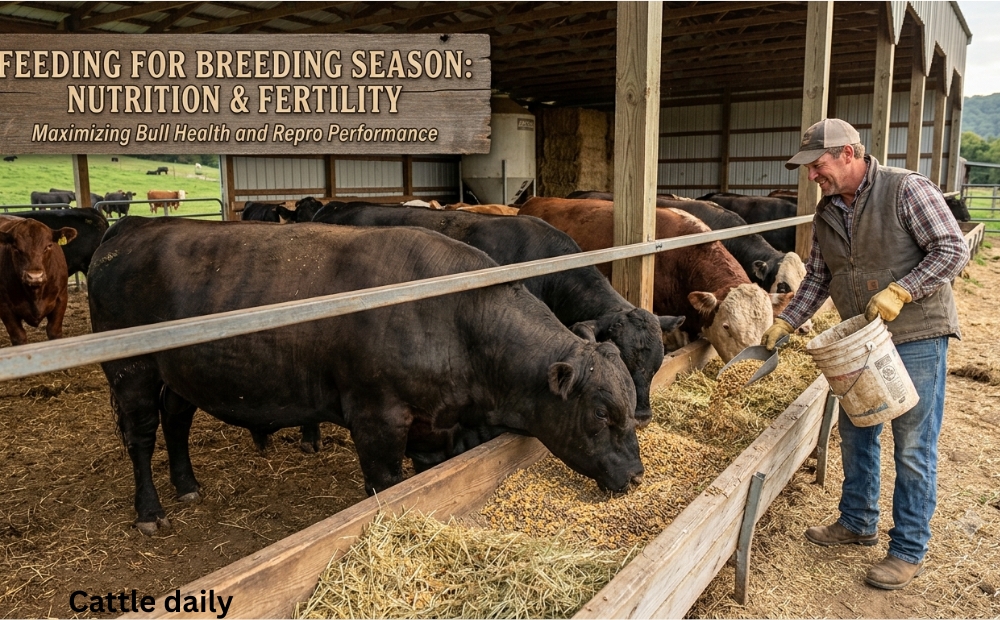
Feeding Bulls for Breeding Season: Nutrition and Fertility
📋 Table of Contents
- Why Bull Nutrition Determines Herd Pregnancy Rates
- Body Condition Score: The Foundation of Bull Readiness
- Nutrient Requirements Before & During Breeding
- Energy Nutrition for Bulls
- Protein and Semen Quality
- Critical Minerals for Bull Fertility
- The 12-Month Bull Feeding Calendar
- Costly Feeding Mistakes That Kill Conception Rates
- Pre-Breeding Management Checklist
- Frequently Asked Questions
- Related Resources
📊 Why Bull Nutrition Determines Herd Pregnancy Rates
In a commercial cow-calf operation, a single bull is responsible for settling 20–35 cows in a 45–60 day breeding season. If that bull's semen quality is compromised, his libido is low, or he lacks the structural soundness and body condition to work through the season, the result is catastrophically expensive: open cows, delayed calving, and a calf crop compressed into a late, narrow window that reduces weaning weights across the board.
Research from multiple university studies estimates that a 10% improvement in 21-day pregnancy rates — the direct result of better bull performance — adds $40–$80 per cow to the gross value of a calf crop. On a 100-cow operation, that's $4,000–$8,000 in additional revenue from one management change. No other single input matches that return on investment.
The biological reality is that spermatogenesis — the production of mature sperm — takes approximately 61 days in bulls. This means that the nutrition a bull receives today determines the semen quality he will deliver 8–9 weeks from now. Pre-breeding nutritional management must begin no later than 60 days before bulls are turned out — and ideally 90 days before for maximum impact on both semen quality and body condition.
time required for complete spermatogenesis — the nutritional window that matters most
target body condition score at bull turnout for optimal breeding performance
cows per bull in a 45–60 day breeding season at peak nutritional status
estimated annual revenue gain from 10% improved 21-day pregnancy rates on 100 cows
⚖️ Body Condition Score: The Foundation of Bull Readiness
Body Condition Score (BCS) is the most practical, immediate assessment of a bull's nutritional status and breeding readiness. BCS reflects the balance between energy intake and energy expenditure over the preceding weeks and months — and it directly predicts both semen quality and the ability to work through an extended breeding season without significant body weight loss.
Severely Thin
Emaciated. Poor semen motility. Low libido. Will not hold up through breeding season. Do NOT turn out.
Below Target
Thin to moderate. Reduced semen quality and libido. Poor stamina. Needs 60–90 days of flushing before use.
✅ Ideal Target
Optimal breeding condition. Good energy reserves. Strong libido and semen quality. Can sustain a full 45–60 day season.
Moderate Excess
Slightly over-conditioned. Watch for reduced libido and increased heat stress risk. May still perform adequately.
Overconditioned
Fat. Significantly reduced libido. Heat stress sensitivity. Structural stress. Will underperform dramatically. Reduce energy ASAP.
How Fast Can You Change BCS?
| BCS Change Needed | Energy Required | Time Required | Action Plan |
|---|---|---|---|
| Gain 1 BCS unit | +6–8 Mcal NEg/day above maintenance | 60–75 days | Flush with high-energy supplement (3–5 lbs grain/day above base ration) |
| Gain 2 BCS units | +6–8 Mcal NEg/day above maintenance | 120–150 days | Begin intensive pre-season conditioning 5 months out |
| Lose 1 BCS unit | Restrict energy to 80–90% of maintenance | 45–60 days | Reduce or eliminate grain; limit hay access; increase exercise |
| Maintain BCS 5–6 | Meet maintenance + moderate growth | Ongoing | Year-round balanced ration — no extreme swings |
🎯 Nutrient Requirements Before & During Breeding
Bull nutrient requirements change significantly across the calendar year based on physiological state, growth stage (young bulls vs. mature bulls), environmental conditions, and breeding activity level. The following targets are based on NRC (National Research Council) recommendations for beef bulls at average U.S. mature weights of 1,800–2,200 lbs.
| Nutrient | Maintenance (Off-Season) | Pre-Breeding (60 days out) | Active Breeding Season | Post-Breeding Recovery |
|---|---|---|---|---|
| NEm (Mcal/day) | 12–14 | 14–16 | 16–20 | 14–16 |
| NEg (Mcal/day) | 0 | 4–6 (if gaining) | 0–2 (maintain) | 4–6 (if recovering) |
| Crude Protein (% DM) | 9–10% | 10–12% | 10–12% | 10–11% |
| TDN (% DM) | 55–60% | 60–65% | 62–68% | 60–65% |
| Dry Matter Intake | 1.8–2.0% BW | 2.0–2.2% BW | 2.0–2.5% BW | 2.0–2.2% BW |
| Calcium (% DM) | 0.20–0.25% | 0.25–0.30% | 0.25–0.35% | 0.25–0.30% |
| Phosphorus (% DM) | 0.15–0.18% | 0.18–0.22% | 0.18–0.25% | 0.18–0.20% |
⚡ Energy Nutrition for Bulls
Energy is the primary driver of body condition, and body condition is the primary driver of bull breeding performance. Getting energy right — not too little, not too much — is the central challenge of bull nutrition management throughout the year.
Energy Requirements During the Breeding Season
During active breeding, bulls are highly active — walking extensively across pasture, fighting for breeding position, and mounting cows repeatedly throughout the day. A working bull in a large pasture with multiple cows cycling simultaneously can cover 10–20 miles per day and mount 5–10 cows. This activity level increases daily energy expenditure by 20–40% above pasture maintenance requirements. Without adequate energy reserves and ongoing energy intake, bulls lose body condition rapidly — often dropping 1–2 BCS units in a 60-day breeding season.
*Values are estimates based on NRC maintenance equations plus activity adjustments. Actual expenditure varies with terrain, temperature, and individual bull behavior.
Best Energy Ingredients for Pre-Breeding Bulls
- Quality grass hay (60–65% TDN): The base of most bull rations during the off-season and pre-breeding period. Provides adequate energy for maintenance and slow BCS improvement. Test for actual TDN — hay quality varies enormously.
- Alfalfa hay (65–72% TDN): Excellent for flushing thin bulls. Higher energy and protein density than grass hay. Valuable for young bulls needing simultaneous growth and fertility support.
- Corn or sorghum grain (3–5 lbs/day): Highly effective for rapid BCS improvement pre-breeding. Limit to 0.4–0.5% of body weight per day to avoid acidosis in forage-based systems. Introduce gradually over 14 days.
- DDGS (1–3 lbs/day): Excellent dual energy-protein supplement for pre-breeding conditioning. Rumen bypass protein supports semen quality simultaneously with energy provision.
- High-quality pasture: During the breeding season itself, well-managed pasture with adequate forage availability (4–6 inches of growth) can nearly meet maintenance energy needs, reducing supplementation requirements significantly.
🧬 Protein and Semen Quality
Protein nutrition directly influences semen production, sperm motility, and sperm morphology. Spermatogenesis is a protein-intensive biological process — every sperm cell must be manufactured from amino acid building blocks, and the accessory sex glands that produce seminal plasma require consistent protein supply to function optimally. Bulls fed adequate energy but inadequate protein consistently produce semen with poor progressive motility and high percentages of morphologically abnormal sperm.
The critical protein concept for bull fertility is not just crude protein percentage, but metabolizable protein (MP) — specifically the amino acids that escape rumen fermentation and are absorbed in the small intestine. For bulls on high-forage diets, rumen bypass protein from sources like DDGS, corn gluten meal, and fish meal is particularly valuable because rumen-degradable protein (RDP) from forages may provide adequate microbial protein for maintenance but insufficient rumen-undegradable protein (RUP) to meet the elevated demands of spermatogenesis.
| Protein Source | CP % | RUP % | Value for Bull Fertility | Ideal Inclusion | Rating |
|---|---|---|---|---|---|
| Soybean meal | 48 | 35 | High-quality AA, good lysine | 1–2 lbs/day pre-breeding | Excellent |
| DDGS | 29 | 60 | High RUP; supports spermatogenesis | 2–4 lbs/day | Excellent |
| Corn gluten meal | 63 | 85 | Very high RUP; reduces rumen dependency | 0.5–1 lb/day | High RUP |
| Alfalfa hay | 18–22 | 20–25 | Good for RDP supply; supports rumen microbes | Ad lib as forage base | Good base |
| Urea | 281 equiv. | 0 | RDP only — no direct fertility benefit | Max 0.2 lbs/day | Limited |
| Canola meal | 37 | 35 | Good methionine — supports sperm development | 1–2 lbs/day | Good |
🧪 Critical Minerals for Bull Fertility
Mineral nutrition is arguably the most overlooked dimension of bull fertility management. Specific trace minerals play direct, irreplaceable roles in sperm cell production, DNA integrity, testosterone synthesis, and antioxidant protection of sperm against oxidative damage during the transit from testes to ejaculation. Deficiencies that are subclinical in cows can be devastating to bull fertility.
| Mineral | Target Level (DM) | Role in Bull Fertility | Deficiency Impact on Semen | Best Sources |
|---|---|---|---|---|
| Zinc | 40–100 ppm | Testosterone synthesis; sperm cell wall integrity; DNA packaging | Poor motility, high abnormal sperm %, low libido | Organic Zn (zinc methionine) preferred; zinc sulfate |
| Selenium | 0.2–0.3 ppm | Antioxidant (GPx enzyme); sperm tail structural protein; motility | Bent sperm tails; poor progressive motility; low viability | Organic Se (Sel-Plex); sodium selenite |
| Copper | 10–15 ppm | Antioxidant (SOD enzyme); sperm production; immune function | Poor sperm output; reduced libido; immune suppression | Organic Cu; copper sulfate (monitor antagonists) |
| Manganese | 20–40 ppm | Testosterone synthesis; antioxidant enzyme cofactor | Reduced testosterone; poor libido; impaired sperm development | Manganese sulfate; organic Mn |
| Vitamin E | 400–600 IU/day | Primary antioxidant protecting sperm membranes from oxidative damage | High lipid peroxidation; poor motility; membrane damage | dl-alpha tocopheryl acetate supplement |
| Vitamin A | 2,200–3,300 IU/lb DM | Spermatogonia development; epithelial integrity of reproductive tract | Degeneration of seminiferous tubules; reduced sperm production | Supplemental Vit A; green forage (beta-carotene) |
| Phosphorus | 0.20–0.30% DM | Sperm motility (ATP energy for flagellar movement) | Reduced sperm motility even when morphology is normal | Dicalcium phosphate; monosodium phosphate |
*Values are approximate ranges compiled from multiple university studies using organic Zn, Se, and Vitamin E supplementation programs begun 60–90 days pre-breeding.
📅 The 12-Month Bull Feeding Calendar
Bull nutrition is not a pre-breeding event — it is a year-round management discipline. The nutritional decisions made at every stage of the year have downstream consequences for breeding performance. The following calendar applies to a spring-breeding program with bulls turned out in late May/early June and removed in late July/early August.
⚠️ Costly Feeding Mistakes That Kill Conception Rates
- Starting pre-breeding nutrition too late: Beginning supplementation 2–3 weeks before turnout is biologically meaningless for semen quality — spermatogenesis takes 61 days. Producers who start conditioning in May for a June breeding season are buying expensive feed that has no impact on the semen quality produced during that breeding season. Start 90 days out.
- Over-conditioning young bulls: First- and second-year bulls are especially susceptible to over-conditioning during the development phase. Fat young bulls entering their first breeding season have poor libido, heat stress vulnerability, and suffer structural stress from excess weight on still-developing skeletal frames. Target BCS 5–5.5 — not 7+.
- Ignoring mineral supplementation between seasons: Year-round mineral deficiencies in zinc, selenium, copper, and Vitamin E accumulate across the body's reserves. Starting a mineral program 30 days before breeding on a chronically deficient bull produces marginal improvement at best. Mineral programs must be year-round to fully fill reserves before the critical 60-day spermatogenesis window.
- Turning bulls out on pasture with no forage assessment: If breeding season pastures are overstocked or undergrown, bulls will lose condition faster than expected during the breeding season itself. Always assess forage availability (target 4–6 inches standing height) before turnout and have a contingency supplement plan if pastures are short.
- Failing to separate bulls from cows post-breeding: Bulls left with cows year-round become chronically lean and chronically stressed. Removing bulls at the end of the breeding season and feeding them separately for recovery is non-negotiable for maintaining productive bull lifespan and performance.
- Skipping the Breeding Soundness Evaluation (BSE): Even perfectly conditioned and fed bulls can have disqualifying reproductive issues — testicular abnormalities, sperm morphology defects, or injury-related infertility that no amount of nutrition can correct. A BSE before every breeding season is the most important reproductive management tool available.
✅ Pre-Breeding Management Checklist
BCS Assessment (90 Days Out)
Score every bull individually. Separate those below BCS 5 for aggressive flushing. Identify those above BCS 7 for restricted rations. Create individual feeding plans.
Start Mineral Program (90 Days Out)
Begin or confirm organic Zinc, Se, Vitamin E program. Review past forage mineral analysis — identify any antagonist risks (high Mo, high S, high Fe) that could compromise trace mineral absorption.
Forage & Feed Testing
Test all hay, silage, and pasture for TDN, CP, and mineral content. Formulate rations to actual nutrient values — not book averages. Identify mineral gaps requiring supplementation.
BSE Scheduling (4–6 Weeks Out)
Schedule Breeding Soundness Evaluation with your vet 4–6 weeks before turnout. This allows time to source replacement bulls if any fail the evaluation. BSE should include motility, morphology, and physical soundness assessment.
Vaccination & Parasite Control
Ensure all bulls are current on IBR, BVD, PI3, BRSV, Leptospirosis, and Vibriosis. Heavy parasite loads reduce feed efficiency and body condition — treat 4–6 weeks before turnout, not at turnout.
Feet, Legs & Structural Check
Evaluate hoof health, leg angles, and joint soundness. Trim feet if needed — a lame bull will not breed. Identify any injury or structural issues. This is the time to make decisions, not during the breeding season.
❓ Frequently Asked Questions
🏁 Conclusion
Bull nutrition is one of the most economically leveraged investments in beef cattle production — yet it is chronically undervalued and poorly managed on many operations. The direct connection between nutritional status 60–90 days before breeding and semen quality, libido, and physical capacity during breeding season creates a narrow, non-negotiable management window. Getting this window right means more cows pregnant in the first cycle, tighter calving distributions, heavier weaning weights, and significantly improved operation profitability.
The fundamentals are clear: assess BCS on every bull 90 days before turnout, feed to achieve BCS 5.5–6.0 at breeding season start, implement a comprehensive organic mineral program centered on zinc, selenium, and Vitamin E, conduct a BSE 4–6 weeks before turnout, and maintain year-round nutritional management so bulls enter the pre-breeding period without major deficits to overcome. A bull properly fed and managed is the most cost-effective fertility tool in any cow-calf operation.