
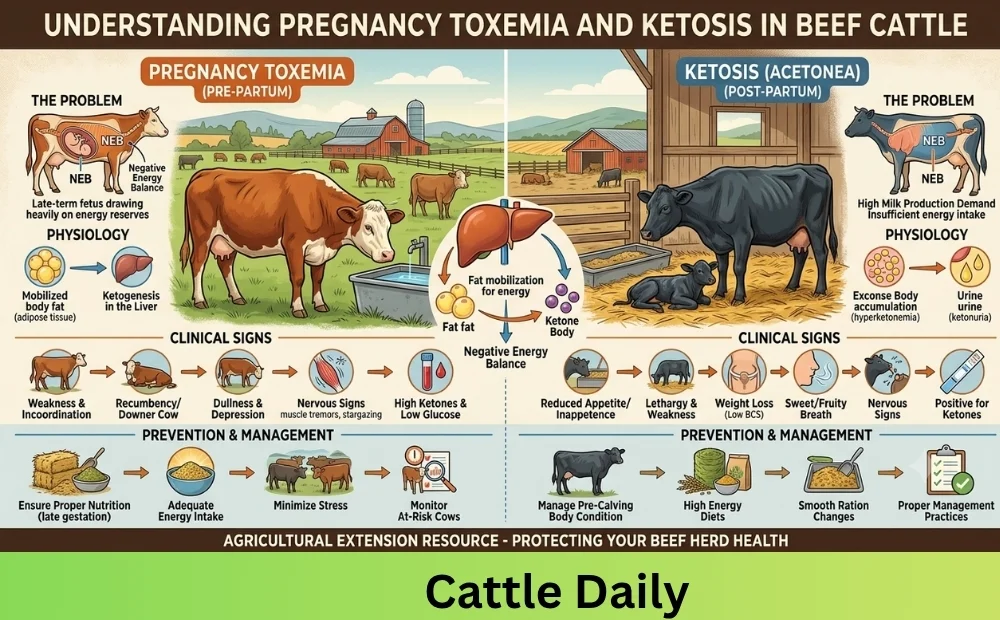
Pregnancy Toxemia and Ketosis in Beef Cattle 2026: Complete Prevention & Treatment Guide
📋 Table of Contents
- Introduction: Why 2026 Is a High-Risk Year
- What Are Pregnancy Toxemia and Ketosis?
- Key Differences Between the Two Conditions
- Causes and Risk Factors
- Clinical Signs and Symptoms
- Diagnosis and Testing
- Treatment Protocols
- Prevention Strategies for 2026
- Nutritional Management
- Economic Impact on Beef Operations
- Frequently Asked Questions
1. Introduction: Why 2026 Is a High-Risk Year
The 2026 beef production season presents unique metabolic challenges for cow-calf operators. With hay prices remaining elevated across most of North America, prolonged drought conditions in key grazing regions, and increased use of low-quality alternative forages, beef cattle are at heightened risk for two closely related metabolic disorders: pregnancy toxemia (a late-gestation disease) and ketosis (typically an early-lactation disease).
Both conditions stem from the same underlying problem — negative energy balance — where the cow's energy demands exceed what she can consume or mobilize from body reserves. Left unchecked, these diseases can cause abortions, dead calves, downer cows, and mortality rates as high as 80% in advanced cases.
2. What Are Pregnancy Toxemia and Ketosis?
Pregnancy toxemia (also called gestational ketosis or "twin lamb disease" in small ruminants) occurs in the last 4–6 weeks of gestation, most commonly in cows carrying twins, over-conditioned (fat) cows, or thin cows on inadequate rations. The rapidly growing fetus demands enormous glucose, and if the cow cannot supply it, she begins breaking down body fat uncontrollably, producing toxic ketone bodies.
Ketosis in beef cattle occurs less commonly than in dairy but affects high-producing beef cows in the first 2–6 weeks after calving, when milk production peaks before dry matter intake catches up. It is a milder, more treatable version of the same metabolic failure.
3. Key Differences Between the Two Conditions
| Feature | Pregnancy Toxemia | Ketosis |
|---|---|---|
| Timing | Last 4–6 weeks of pregnancy | First 2–6 weeks of lactation |
| Most at Risk | Twin-bearing, fat, or thin cows | High-producing early-lactation cows |
| Onset | Sudden, rapid deterioration | Gradual decline |
| Mortality | Up to 80% if untreated | Under 5% with treatment |
| Blood Glucose | Very low (<40 mg/dL) | Low to normal |
| Ketone Levels | Extremely high | Moderately elevated |
| Prognosis | Guarded to poor | Good with early treatment |
4. Causes and Risk Factors
Understanding what triggers these disorders is the first step in prevention. In 2026, several converging factors have amplified the risk.
Primary Causes
- Negative energy balance: Energy demand exceeds intake, forcing fat mobilization.
- Multiple fetuses: Twin pregnancies double glucose demand in the last trimester.
- Body condition extremes: Both fat (BCS 7+) and thin (BCS 4 or less) cows are at high risk.
- Sudden feed changes: Abrupt switches to low-quality hay or crop residues.
- Cold stress: Winter weather increases maintenance energy needs by 20–40%.
- Concurrent disease: Foot rot, pneumonia, or parasites reducing intake.
📊 Relative Risk Factors for Pregnancy Toxemia (2026 Field Data)
5. Clinical Signs and Symptoms
Early recognition is critical. Signs progress rapidly, especially in pregnancy toxemia.
Early Signs (Stage 1)
- Decreased appetite, particularly for grain
- Slight depression and separation from the herd
- Reduced rumination
- Sweet, fruity (acetone) smell on breath
Advanced Signs (Stage 2)
- Complete anorexia
- Muscle tremors and weakness
- Grinding teeth (bruxism)
- Star-gazing posture or head-pressing
- Blindness or apparent disorientation
Terminal Signs (Stage 3)
- Recumbency (downer cow)
- Coma
- Fetal death and abortion
- Death within 3–7 days if untreated
6. Diagnosis and Testing
Diagnosis combines clinical signs with laboratory confirmation. On-farm tests have improved significantly in recent years.
| Test | Sample | Positive Result | Cost (2026) |
|---|---|---|---|
| Urine ketone strips | Fresh urine | Moderate to large ketones | $0.25/test |
| Milk ketone strips | Fresh milk | Purple color change | $0.50/test |
| Handheld BHB meter | Whole blood | >1.2 mmol/L subclinical; >3.0 clinical | $1–2/test |
| Blood glucose | Serum | <40 mg/dL indicates toxemia | Lab: $8–15 |
| NEFA (fatty acids) | Serum | >0.7 mmol/L pre-calving | Lab: $10–18 |
7. Treatment Protocols
Treatment goals are to restore blood glucose, halt fat mobilization, and support the cow through recovery. Consult your veterinarian before administering any therapy.
Standard Treatment Protocol
- IV dextrose: 500 mL of 50% dextrose slowly IV — provides immediate glucose.
- Propylene glycol: 300 mL orally twice daily for 3–5 days — a gluconeogenic precursor.
- Calcium borogluconate: 500 mL SC or IV if hypocalcemia is suspected.
- B-vitamin complex: Especially B12 and niacin to support metabolism.
- Corticosteroids: Dexamethasone may be used to induce parturition in late-stage toxemia (veterinarian decision).
- Supportive care: Palatable feed, fresh water, comfortable bedding, warmth.
8. Prevention Strategies for 2026
Prevention is dramatically more cost-effective than treatment. A comprehensive program includes body condition management, nutrition, and monitoring.
Top 7 Prevention Practices
- Target BCS 5.5–6 at calving — avoid both fat and thin cows.
- Preg-check and identify twin pregnancies — provide extra nutrition to these cows.
- Never let cows lose more than 1 BCS in late gestation.
- Test forages for energy and protein — don't guess.
- Provide windbreaks and bedding during cold stress events.
- Maintain a proper mineral program year-round.
- Introduce feed changes gradually over 7–10 days.
9. Nutritional Management
Nutrition is the cornerstone of prevention. Late-gestation beef cows require significantly more energy than early-gestation cows.
| Stage of Production | TDN (%) | Crude Protein (%) | Daily DM Intake (lb) |
|---|---|---|---|
| Mid-gestation | 52 | 7.0 | 24–26 |
| Late gestation (single) | 58 | 9.0 | 26–28 |
| Late gestation (twins) | 65 | 11.0 | 28–30 |
| Early lactation | 65 | 11.5 | 30–34 |
📊 Energy Demand Increase in Late Gestation
10. Economic Impact on Beef Operations
The financial cost of pregnancy toxemia extends far beyond the treatment bill.
| Loss Category | Cost per Case (2026 USD) |
|---|---|
| Dead cow (mature) | $2,200–$2,800 |
| Lost calf | $900–$1,400 |
| Veterinary treatment | $150–$450 |
| Reduced future fertility | $300–$600 |
| Labor and monitoring | $75–$200 |
| Total potential loss per case | $3,625–$5,450 |
11. Frequently Asked Questions
Q1: Can pregnancy toxemia occur in first-calf heifers?
Yes. Heifers are actually at increased risk because they are still growing while pregnant, doubling their nutritional demand. Feed heifers separately from mature cows to ensure adequate intake.
Q2: How quickly should I see improvement after treatment?
With prompt IV dextrose and oral propylene glycol, mild cases often show improved alertness and appetite within 12–24 hours. Advanced cases with recumbency have a poorer prognosis, and recovery may take 5–7 days or may not occur at all.
Q3: Is ketosis contagious between cows?
No, ketosis is a metabolic disease, not an infectious one. However, if multiple cows develop it, it points to a herd-level nutritional problem that needs immediate correction.
Q4: Can I use molasses instead of propylene glycol?
Molasses provides quick sugar but is metabolized differently and does not effectively stop fat mobilization the way propylene glycol does. Propylene glycol remains the gold standard oral treatment.
Q5: What body condition score is safest for late-gestation cows?
Target a BCS of 5.5 to 6 on the 9-point scale at calving. Cows above 7 are at high risk for pregnancy toxemia, and cows below 5 lack the reserves to support late-gestation and early lactation demands.
🔗 Related Articles from CattleDaily
- Lumpy Jaw and Wooden Tongue in Cattle
- Polled vs Horned Cattle: Which Is Better?
- Alternative Feeds for Cattle When Hay Is Too Expensive
- Building an Effective Cattle Mineral Program
- How Weather and Season Affect Cattle Feed Requirements
- Calf Scours: Causes, Treatment & Prevention
Visit CattleDaily.com for more expert cattle management guides.