
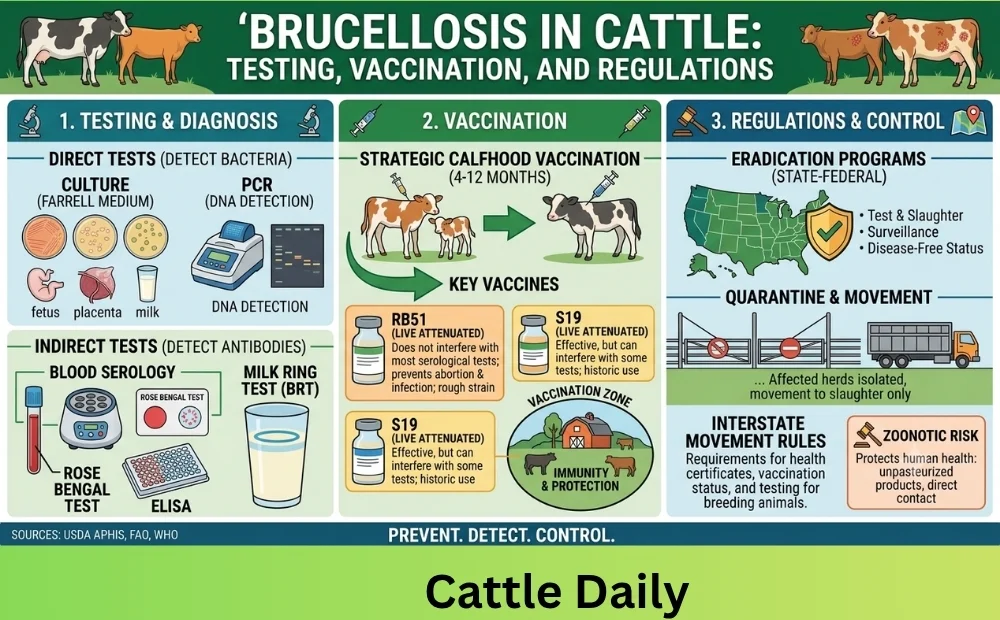
Brucellosis in Cattle: Testing, Vaccination, and Regulations (2026 Guide)
📋 Table of Contents
- Introduction: Why Brucellosis Still Matters in 2026
- What Is Brucellosis?
- How Brucellosis Spreads
- Clinical Signs in Cattle
- Zoonotic Risk: Undulant Fever in Humans
- Testing Methods and Protocols
- Vaccination: RB51 Program
- Regulations and Reporting Requirements
- Biosecurity and Prevention
- Economic Impact
- Frequently Asked Questions
1. Introduction: Why Brucellosis Still Matters in 2026
Although the United States achieved Class Free status for cattle brucellosis in most states by the early 2000s, the disease is not gone. A persistent wildlife reservoir in the Greater Yellowstone Area (elk and bison), combined with global trade and the movement of cattle across borders, keeps brucellosis a real threat in 2026. Outbreaks in Montana, Wyoming, and Idaho over the last five years have reminded producers that vigilance, testing, and vaccination remain essential.
Beyond the herd-level impact, brucellosis is a zoonotic disease — meaning it can infect humans — making it a public health as well as an agricultural concern.
2. What Is Brucellosis?
Brucellosis in cattle is caused primarily by Brucella abortus, a gram-negative bacterium that lives inside host cells. Related species affect other animals: B. melitensis (goats/sheep), B. suis (swine), and B. canis (dogs). All can potentially infect humans.
The bacterium has a strong affinity for reproductive tissues, especially the pregnant uterus, placenta, and mammary gland, which is why abortion in the last trimester is the hallmark sign.
3. How Brucellosis Spreads
Brucella is shed in enormous numbers at calving or abortion. The main routes of transmission are:
- Ingestion of contaminated placenta, fetal fluids, or feed/water.
- Licking of aborted fetuses or newborn calves — very common in curious cattle.
- Contaminated milk — calves nursing from infected cows.
- Venereal transmission — less common but possible via natural service.
- Wildlife exposure — infected elk and bison in the Greater Yellowstone Area.
- Contaminated fomites — boots, trailers, equipment.
📊 Primary Transmission Routes in Reported U.S. Outbreaks
4. Clinical Signs in Cattle
Brucellosis is often silent until reproductive losses appear. Key signs include:
- Late-term abortion (5th to 9th month of pregnancy) — the classic sign.
- Retained placenta and metritis after abortion or calving.
- Stillbirths and weak calves at term.
- Reduced fertility — repeat breeders, extended calving intervals.
- Milk yield drop in dairy cows.
- Hygroma — fluid swelling on knees or hocks (in chronic cases).
- Bulls: Orchitis, epididymitis, reduced fertility.
5. Zoonotic Risk: Undulant Fever in Humans
Humans typically contract brucellosis by handling infected tissues without protection, consuming unpasteurized dairy, or through mucosal splashes. The human disease is called undulant fever because of its recurring fever pattern.
Symptoms include prolonged fever, night sweats, joint pain, fatigue, and depression. It can become chronic and difficult to treat, requiring weeks of combination antibiotic therapy.
6. Testing Methods and Protocols
Reliable diagnosis relies on serologic tests, culture, and PCR. Multiple tests are often used in combination.
| Test | Sample | Use | Turnaround |
|---|---|---|---|
| Brucellosis Ring Test (BRT) | Bulk tank milk | Dairy herd screening | 1–2 days |
| Buffered Acidified Plate Antigen (BAPA) | Serum | Rapid screening at market | Same day |
| Card test / Rose Bengal | Serum | Field screening | Minutes |
| Fluorescence Polarization Assay (FPA) | Serum | Confirmation, high sensitivity | 1–3 days |
| Complement Fixation Test (CFT) | Serum | Confirmatory international trade | 3–5 days |
| PCR | Tissue, milk, blood | Direct pathogen detection | 1–3 days |
| Bacterial culture | Fetal tissue, placenta, milk | Gold standard confirmation | 1–3 weeks |
When to Test
- Before movement across state lines (as required by regulation).
- Before sale at auction markets.
- At change of ownership.
- Following any abortion investigation.
- Routine surveillance in Designated Surveillance Areas (DSAs).
7. Vaccination: RB51 Program
The RB51 vaccine is the current USDA-approved vaccine for cattle brucellosis. It replaced the older Strain 19 vaccine because RB51 does not interfere with standard serologic tests, making surveillance easier.
RB51 Vaccination Facts
- Who administers: Only a USDA-accredited veterinarian or state/federal animal health official.
- Age: Heifer calves between 4 and 12 months of age.
- Route: Subcutaneous injection.
- Identification: Vaccinated animals receive an official tattoo in the right ear and a metal or RFID orange "Brucellosis Vaccination" tag.
- Duration of immunity: Generally lifelong protection against clinical disease, though not 100% sterile immunity.
📊 Impact of Widespread RB51 Vaccination (U.S. Historical Trend)
8. Regulations and Reporting Requirements
Brucellosis in cattle falls under a coordinated federal-state framework managed by USDA APHIS and state veterinarians. Key regulations in 2026 include:
Interstate Movement Requirements
- Test-eligible cattle (typically sexually intact cattle 18 months or older) must have a negative brucellosis test within 30 days of interstate movement — unless from a Class Free state and meeting exemption criteria.
- All interstate movement requires a Certificate of Veterinary Inspection (CVI).
- Official individual identification (RFID or approved ear tag) is required.
Designated Surveillance Areas (DSAs)
In the Greater Yellowstone Area (parts of Montana, Wyoming, and Idaho), enhanced surveillance rules apply because of the wildlife reservoir. Cattle in DSAs are subject to:
- Mandatory herd testing on an annual or biennial basis.
- Testing before movement out of the DSA.
- Mandatory RB51 vaccination of heifer calves.
State Status Categories
| Status | Meaning | Requirements |
|---|---|---|
| Class Free | <0.25% herd prevalence for 12+ months | Minimal testing for movement |
| Class A | <0.25% herd prevalence for shorter period | Moderate testing requirements |
| Class B | 0.25%–1.5% herd prevalence | Enhanced testing and controls |
| Class C | >1.5% herd prevalence | Strict controls, movement restrictions |
Reporting
Brucellosis is a federally reportable disease under the National Animal Health Reporting System. Any suspicion must be reported to the state veterinarian or USDA APHIS Area Veterinarian in Charge within 24 hours.
9. Biosecurity and Prevention
Preventing brucellosis introduction is far cheaper than dealing with an outbreak.
Top Biosecurity Practices
- Buy from known-negative herds and require test results before purchase.
- Quarantine new arrivals for at least 30 days and retest before mixing.
- Vaccinate heifer calves with RB51 in DSAs or high-risk areas.
- Prevent wildlife contact — fencing, hay storage, and elk-cattle separation during elk calving season.
- Handle abortions safely — wear PPE, disinfect the area, and submit fetuses for diagnosis.
- Clean and disinfect calving areas after every use.
- Do not feed unpasteurized milk to calves from untested cows.
10. Economic Impact
A brucellosis outbreak can be devastating financially, with losses continuing long after the diagnosis.
| Loss Category | Estimated Impact (2026 USD) |
|---|---|
| Aborted calf | $900–$1,500 each |
| Reduced fertility per exposed cow | $250–$500/year |
| Herd depopulation (worst case) | $1,800–$2,800 per head |
| Movement restrictions and lost sales | Variable, often $10,000+ per operation |
| Testing and veterinary costs | $8–$25 per animal tested |
| Reputation and market access loss | Long-term, difficult to quantify |
11. Frequently Asked Questions
Q1: Is brucellosis still a threat in the United States in 2026?
Yes, though the U.S. cattle industry has largely eliminated the disease from commercial herds. The main ongoing risk is in the Greater Yellowstone Area, where infected elk and bison can transmit the bacterium to cattle. Cases are also occasionally introduced through imported animals or unregulated movement.
Q2: Can bulls be vaccinated with RB51?
No. RB51 is approved only for heifer calves between 4 and 12 months of age. Vaccination of bulls or non-heifer cattle is not permitted and can cause adverse reactions, including orchitis and shedding in semen.
Q3: Can I drink milk from a brucellosis-vaccinated cow?
Yes — provided the milk is pasteurized. Pasteurization destroys Brucella organisms. Never consume raw milk from cattle of unknown brucellosis status, as it can cause serious human illness.
Q4: What happens if a cow tests positive for brucellosis?
A positive test triggers immediate quarantine of the herd. The state veterinarian will conduct confirmatory testing, trace-back and trace-forward investigations, and — depending on results — order testing of the entire herd. Infected animals are typically sent to slaughter with indemnity, and the herd may face months of restrictions.
Q5: How can I tell brucellosis abortion from other causes?
You can't tell by appearance alone. Brucellosis abortions typically occur in the last trimester and are often accompanied by retained placenta, but so are abortions caused by leptospirosis, IBR, BVD, and neosporosis. Always submit aborted fetuses and placenta to a diagnostic lab for testing.
🔗 Related Articles from CattleDaily
- Building an Effective Cattle Mineral Program
- How Weather and Season Affect Cattle Feed Requirements
- Calf Scours: Causes, Treatment & Prevention
- Pregnancy Toxemia and Ketosis in Beef Cattle
- Cattle Lameness: Causes, Scoring, and Treatment
Visit CattleDaily.com for more expert cattle management guides.