
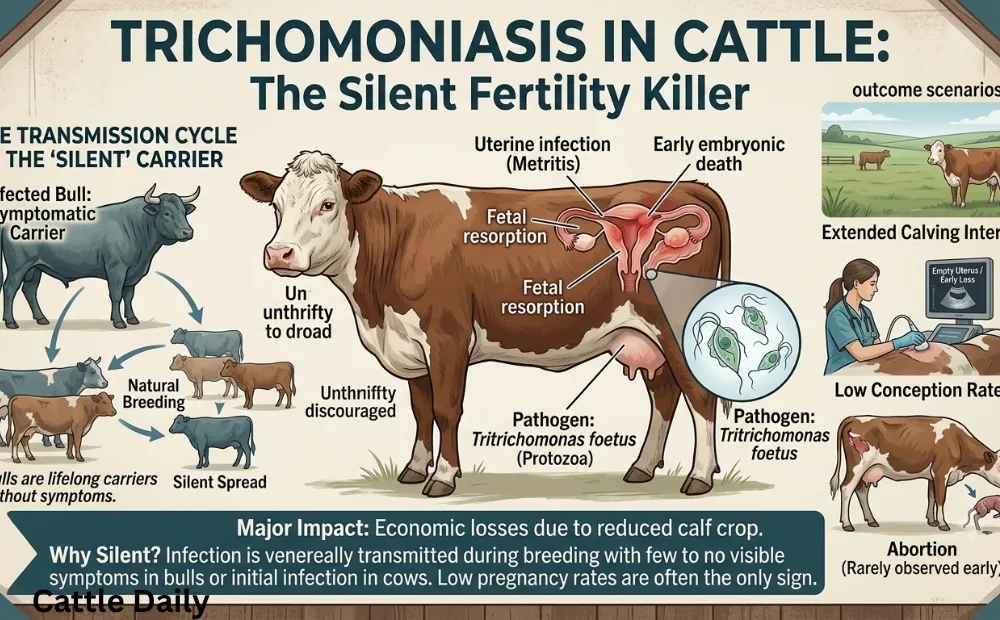
Trichomoniasis in Cattle: The Silent Fertility Killer (2026 Guide)
📋 Table of Contents
- Introduction: Why "Trich" Is So Dangerous
- What Is Trichomoniasis?
- How Trichomoniasis Spreads
- Clinical Signs in Bulls and Cows
- Economic Impact on Beef Herds
- Testing Methods and Sampling
- Treatment: Why There Is No Cure
- Prevention and Herd Biosecurity
- State Regulations and Bull Testing
- Handling an Outbreak
- Frequently Asked Questions
1. Introduction: Why "Trich" Is So Dangerous
Trichomoniasis has earned the nickname "the silent fertility killer" because it produces virtually no outward signs in either bulls or cows — yet it can slash pregnancy rates from 90% down to 50% or lower within a single breeding season. In 2026, with bred-cow values at historic highs and calf prices near record levels, an undetected trich outbreak can cost a mid-sized cow-calf operation six figures in lost revenue in a single year.
Unlike most reproductive diseases, trichomoniasis has no vaccine that reliably prevents infection, no effective treatment approved for use in the U.S., and no way to visually detect infected animals. Prevention through biosecurity and testing is the only real defense.
2. What Is Trichomoniasis?
Bovine trichomoniasis is caused by Tritrichomonas foetus, a single-celled, pear-shaped protozoan parasite that lives in the reproductive tract of infected cattle. The organism has three characteristic anterior flagella and an undulating membrane, giving it its distinctive motility under a microscope.
In bulls, the parasite colonizes the folds (crypts) of the prepuce and penis, especially in older bulls whose prepuce has developed deeper crypts with age. In cows, it inhabits the vagina, cervix, and uterus.
3. How Trichomoniasis Spreads
Trichomoniasis is almost exclusively a venereal disease — transmitted during natural breeding. A single infected bull can spread the parasite to dozens of cows in one breeding season, and each newly infected cow can then pass it to any bull that breeds her.
Main Transmission Routes
- Natural mating — the primary and by far most common route.
- Contaminated semen — a real risk with poorly processed fresh semen; commercial frozen AI semen is essentially risk-free.
- Contaminated AI equipment — rare but possible if instruments are shared between cows without sanitation.
- Fence-line contact — the parasite does NOT spread through casual contact, feed, water, or shared pastures without breeding.
📊 How a Single Infected Bull Spreads Trich in One Season
4. Clinical Signs in Bulls and Cows
The most dangerous feature of trichomoniasis is that infected animals appear completely normal. There is no fever, no discharge in most cases, no lameness — nothing to alert the rancher.
In Bulls
- No visible symptoms — bulls remain healthy, breed enthusiastically, and pass semen evaluations.
- Some may show mild preputial discharge, but this is rare.
- Bulls typically remain lifelong carriers once infected past age 4.
In Cows
- Early embryonic death — usually 30 to 90 days into pregnancy.
- Return to heat at irregular intervals (35–70 days).
- Pyometra (pus-filled uterus) in some chronic cases.
- Occasional abortion in the first 4–5 months of pregnancy.
- Most cows self-cure in 3–6 months if given sexual rest, but a small percentage remain carriers into the next season.
Herd-Level Red Flags
- Pregnancy rate drops below 85%.
- Long calving season, "strung-out" calving pattern.
- High percentage of open cows at preg-check.
- Cows returning to heat 60+ days after being bred.
- New bull introductions in the recent past — especially older, unproven bulls.
5. Economic Impact on Beef Herds
| Loss Category | Estimated Impact (2026 USD) |
|---|---|
| Lost calf per open cow | $1,100–$1,600 |
| Extended calving interval / late calves | $150–$300 per cow |
| Culling of chronically open cows | $400–$900 replacement cost |
| Testing and veterinary work | $40–$75 per bull tested |
| Bull culling | $2,000–$4,500 per infected bull |
| Feed cost carrying open cows | $400–$700 per open cow |
6. Testing Methods and Sampling
Because bulls are the reservoir, testing focuses on bulls. Cow testing is used mainly in outbreak investigations.
Bull Sampling
A veterinarian collects a preputial scraping using a dry pipette or brush inserted deep into the prepuce. The sample is placed into transport media (usually InPouch TF) and either cultured or submitted for PCR testing.
| Test | Method | Sensitivity | Turnaround |
|---|---|---|---|
| InPouch TF culture | Live organism growth, microscopy | ~80% per single test | 3–7 days |
| PCR | DNA detection from pouch or direct sample | >95% per single test | 1–3 days |
| Real-time PCR (pooled) | Efficient herd-level screening | >95% | 1–3 days |
- Bulls must have at least 2 weeks of sexual rest before sampling — recent breeding dilutes the organism.
- Most states require 3 consecutive negative tests at 7-day intervals before a bull is officially considered negative.
- Use PCR when speed matters and culture when the lab wants to preserve the isolate.
7. Treatment: Why There Is No Cure
Here is the hard truth: there is no legal, effective treatment for trichomoniasis in cattle in the United States. The drugs that historically worked (metronidazole, ipronidazole, dimetridazole) are all prohibited from use in food-producing animals by the FDA because of residues and carcinogenic concerns.
Standard Management of Positive Bulls
- Slaughter — the only accepted management strategy.
- Do not attempt to treat or "cure" the bull — it is illegal and ineffective.
Management of Exposed Cows
- Provide 90–120 days of sexual rest; most cows self-cure.
- Test open cows if suspicion remains high.
- Consider culling repeat-open cows to remove any lingering carriers.
Vaccination
A commercial killed vaccine (TrichGuard) is available. It does not prevent infection but has been shown to reduce the duration of infection in cows and improve conception rates in affected herds. It is not a substitute for testing bulls and biosecurity.
8. Prevention and Herd Biosecurity
Top 8 Prevention Strategies
- Use only virgin bulls or bulls with recent negative trich tests.
- Test all new bulls before turning them out with cows.
- Retire and cull older bulls (age 5+) sooner rather than later.
- Maintain strong fences — a single fence-jumping neighbor's bull can wreck a herd.
- Preg-check all cows annually and cull opens.
- Use AI where practical — commercial frozen semen is trich-free.
- Quarantine and test any purchased breeding animal.
- Consider vaccination as an added layer in high-risk regions.
📊 Impact of Layered Biosecurity on Trich Risk
9. State Regulations and Bull Testing
Trichomoniasis is regulated at the state level, and rules vary. In 2026, the majority of Western and Plains states have mandatory bull testing requirements for interstate movement or change of ownership. Common regulations include:
- All non-virgin bulls must have a negative trich test within 30–60 days before sale, movement, or lease.
- Virgin bulls under 18–24 months (varies by state) may be exempt with a virgin bull certificate.
- Trich is a reportable disease in many states — positive bulls must be reported to the state veterinarian.
- Interstate movement typically requires a Certificate of Veterinary Inspection (CVI) listing test results.
- Some states quarantine positive herds until all bulls test negative and infected bulls are slaughtered.
10. Handling an Outbreak
If pregnancy rates crash and trichomoniasis is confirmed, act decisively:
- Test every bull immediately using PCR — do not wait for culture.
- Slaughter positive bulls — no exceptions, regardless of value.
- Isolate exposed cows and provide 90–120 days of sexual rest.
- Preg-check all cows at 60 days after the bull turnout to identify late conceptions.
- Cull chronically open cows to prevent carriers persisting into the next season.
- Restock with virgin bulls or tested-negative bulls only.
- Vaccinate the cow herd with TrichGuard as an added safeguard.
- Improve fencing to prevent reintroduction from neighboring herds.
11. Frequently Asked Questions
Q1: Can cows spread trichomoniasis to bulls?
Yes. Trichomoniasis is a two-way venereal disease. An infected cow can transmit the parasite to a clean bull during breeding, and that bull can then infect every other cow he services. This is why culling opens and providing sexual rest matters.
Q2: Are virgin bulls really safe?
Virgin bulls that have never bred a cow are essentially trich-free, since the disease is venereally transmitted. However, "virgin" status must be documented — bulls raised in bull pens away from cows and certified by the seller. Any doubt means test before use.
Q3: Will artificial insemination protect my herd?
Yes, when using commercial frozen semen from reputable studs. Frozen semen goes through washing and processing that essentially eliminates the parasite. On-farm fresh-collected semen from a non-tested bull, however, is NOT safe.
Q4: How long does the parasite survive outside the animal?
Tritrichomonas foetus is fragile outside the host and dies within minutes to hours in the environment. It does not survive freezing, drying, or disinfectants well. This is why the disease does not spread through pastures, water troughs, or casual contact — only through breeding.
Q5: Does the trich vaccine (TrichGuard) actually work?
It helps but is not a silver bullet. Studies show the vaccine reduces the duration of infection in cows and can modestly improve pregnancy rates in affected herds. It does not prevent bulls from becoming infected or spreading the parasite, and it does not eliminate the need for bull testing. Consider it a supplement, not a substitute, for proper biosecurity.
🔗 Related Articles from CattleDaily
- Building an Effective Cattle Mineral Program
- How Weather and Season Affect Cattle Feed Requirements
- Calf Scours: Causes, Treatment & Prevention
- Pregnancy Toxemia and Ketosis in Beef Cattle
- Cattle Lameness: Causes, Scoring, and Treatment
Visit CattleDaily.com for more expert cattle management guides.