
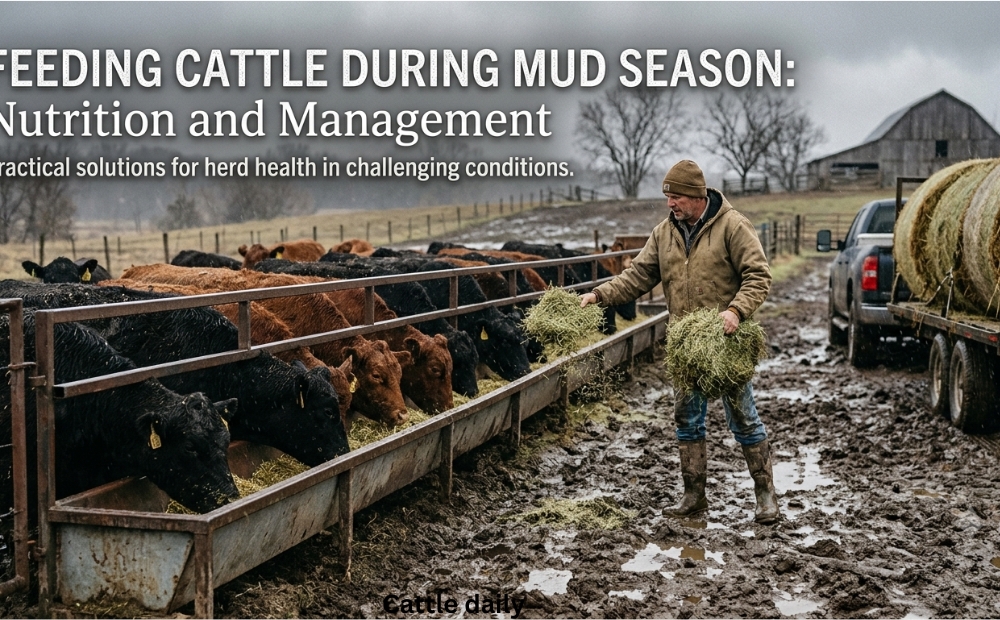
Feeding Cattle
During Mud Season
Nutrition & Management
🌧️ Why Mud Season Is a Nutrition Crisis
Most producers plan their winter feeding program carefully — they test forages, balance rations, and budget hay costs with precision. Then mud season arrives and silently undoes much of that work. Mud is not just an inconvenience. From a nutritional standpoint, it is a chronic energy drain, a feed waste multiplier, and a disease incubator that operates simultaneously on every cow in the lot.
The problem is multi-layered. Cattle standing in mud expend significantly more energy just to maintain body temperature — mud conducts heat away from hooves and legs far faster than air or dry bedding. The mechanical effort of moving through deep mud burns additional calories. Wallowing, stress behaviours, and disrupted resting patterns compound the deficit further. And while all this is happening, your carefully placed hay bales are sinking into the ground and being trampled underfoot.
⚡ The Energy Math: How Much More Do They Need?
University research, primarily from Kansas State, South Dakota State, and North Dakota State extension programs, has quantified the energy increase needed in muddy conditions. The benchmark metric is Net Energy for Maintenance (NEm) — the energy a cow must consume before any production (growth, milk, reproduction) can occur.
To put these numbers in practical terms: a cow that needs 28 lbs of good grass hay (12% CP, 54% TDN) per day in dry conditions may need 34–36 lbs of the same hay standing in 6–8 inches of mud — before accounting for any hay she's wasting by trampling. At $280/ton, that's an additional $0.84–1.12/cow/day in hay cost from mud alone, or $63–84 per cow over a 75-day mud period.
| Mud Depth | NEm Increase | Extra Hay/Day (lbs) | Extra Cost/Day | Extra Cost / 75 Days | Management Priority |
|---|---|---|---|---|---|
| None (dry) | +0% | 0 lbs | $0 | $0 | Normal |
| Ankle (2–4") | +7% | +2 lbs | +$0.28 | +$21 | Monitor |
| Fetlock (4–6") | +15% | +4 lbs | +$0.56 | +$42 | Supplement |
| Knee deep (6–10") | +25% | +7 lbs | +$0.98 | +$74 | Urgent Action |
| Severe (10"+) | +30–40% | +8–11 lbs | +$1.12–1.54 | +$84–116 | Emergency |
📊 Mud Stress Index: What's Compounding on Your Herd
Mud season stress rarely comes from a single source. The danger is that multiple stressors arrive simultaneously and compound each other. The Mud Stress Index below illustrates how different factors interact during a typical late-winter/early-spring mud event:
🌾 Nutrition Adjustments by Production Stage
Mud season nutrition adjustments cannot be one-size-fits-all — a dry cow in mid-gestation and a peak-lactation cow with a 3-week-old calf have very different baseline needs, and therefore very different supplementation requirements when mud adds to the load.
| Production Stage | Base CP Req. | Base NEm Req. | Mud Adjustment | Recommended Supplement | Priority |
|---|---|---|---|---|---|
| Dry cow, early gestation | 7–8% CP | 12.7 Mcal/day | +2–4 lbs hay equiv. | 2–3 lbs DDGS or corn/day | Moderate |
| Dry cow, last 60 days | 9–10% CP | 14.5 Mcal/day | +3–5 lbs hay equiv. | 3–4 lbs DDGS + 1 lb protein cube | High |
| Lactating cow, early (0–90 days) | 11–13% CP | 17.2 Mcal/day | +4–6 lbs hay equiv. | 4–5 lbs DDGS or corn silage top-up | Critical |
| Stocker (400–750 lb, 2 lb/day gain) | 13–15% CP | 9.4 Mcal/day | +1.5–3 lbs hay equiv. | 2–3 lbs DDGS; reduce gain target | Moderate |
| First-calf heifer (calving) | 11–12% CP | 14.8 Mcal/day | +3–5 lbs hay equiv. | 3–4 lbs DDGS + separate from mature cows | Critical |
| Bull (breeding season prep) | 8–9% CP | 16.5 Mcal/day | +2–3 lbs hay equiv. | 2 lbs corn or DDGS to maintain BCS 5–6 | Moderate |
Key Nutrients to Watch in Mud Season
- Energy (NEm) — Priority #1. Add 15–30% more energy-dense feed relative to your standard winter ration. Corn grain (0.94 Mcal NEm/lb) and DDGS (0.83 Mcal NEm/lb) are the most cost-efficient energy boosts.
- Vitamin E & Selenium. Wet, mature forage is notoriously deficient in both. Selenium is particularly critical for immune function and retained placenta prevention in late-gestation cows. Boost injectable Se or increase selenium in mineral during mud season.
- Copper & Zinc. High moisture and manure-contaminated forage ties up copper absorption. Zinc is especially important for hoof integrity — deficiency worsens the tissue breakdown that begins with prolonged mud exposure.
- Vitamin A. Dormant or low-quality wet forage delivers minimal beta-carotene. Cows going into calving short on Vitamin A have weaker colostrum and less robust newborn calves. Supplement 50,000–80,000 IU/day during extended mud events.
- Protein (RDP specifically). Cold, wet conditions slow rumen fermentation. Ensure adequate rumen-degradable protein to maintain microbial populations and forage digestibility — the rumen microbes extracting energy from your hay need nitrogen to function.
For a deeper understanding of how energy and protein work together in the rumen, our article on Total Mixed Ration (TMR) for Cattle explains nutrient synchrony and why supplement timing matters.
🚜 Feed Delivery & Waste Management in Mud
Even a perfectly balanced ration fails if it never reaches the cow's mouth in usable form. Mud dramatically increases feed wastage at every step — from delivery to consumption. University studies estimate hay waste in muddy feedlot conditions ranges from 25–50% for open ring feeders, compared to 5–10% in dry conditions with the same equipment.
✅ Do These in Mud Season
- Use covered cone feeders or sheeted ring feeders to keep hay dry and off the ground
- Deliver feed on elevated pads, gravel, or crushed rock where possible
- Move bales frequently — don't let cattle congregate and compact one feeding area
- Feed silage or dense supplements (DDGS, cubes) over hay where possible — they pack less waste
- Increase feeding frequency — twice-daily feeding in mud keeps cattle from running through rations
- Move feeders to higher ground or lot high spots to create a dry congregation area
- Use feed bunks rather than ground feeding for supplements and grain
- Apply gravel, wood chips, or concrete pads around water tanks and feed areas
❌ Avoid These Mistakes
- Don't feed hay on the ground in a muddy lot — wastage of 40–60% is common
- Don't ignore BCS decline — wait-and-see costs more in calving problems than early supplementation
- Don't crowd cattle onto the last dry area — creates social stress, disease spread, and injury
- Don't skip minerals because "they get it in the hay" — wet hay has severely reduced mineral bioavailability
- Don't apply full energy cuts if BCS is already below 5 — mud season is not the time to save money on feed
- Don't forget water quality — check tanks for manure runoff contamination after rain events
🐾 Hoof Health & Foot Rot Prevention
Prolonged mud exposure is the #1 environmental risk factor for foot rot (infectious pododermatitis) in beef cattle. The combination of wet, softened hoof tissue, constant manure exposure, and the puncture-prone mud environment creates ideal conditions for Fusobacterium necrophorum and Bacteroides melaninogenicus — the bacteria responsible for clinical foot rot.
| Hoof Condition | Cause in Mud Season | Early Signs | Prevention | Treatment |
|---|---|---|---|---|
| Foot Rot | Bacterial invasion of softened interdigital tissue | Sudden severe lameness; swelling between toes; foul odour | Footbaths with ZnSO₄ or CuSO₄ 3×/week; Zn supplementation | Penicillin/oxytetracycline IM; LA-200; consult vet |
| Hairy Heel Warts | Spirochaete bacteria; wet, dirty conditions | Painful proliferative lesion at heel/coronary band | Footbath; avoid high cattle density in wet areas | Topical oxytetracycline; bandaging; vet consult |
| Sole Bruising | Rocky-mud mix; walking on firm debris under mud | Mild lameness; heat in hoof; pink/red sole | Clear rocky material from lot; bedding on resting pads | Rest; NSAID if severe; consult vet |
| White Line Disease | Hoof wall separation from softened tissue | Lameness; cracked or separated hoof wall | Dry bedding; zinc supplementation; trimming | Hoof trimming; packing; antibiotic if infected |
🦠 Elevated Disease Pressure in Mud Conditions
Mud doesn't just affect nutrition — it dramatically alters the herd's disease landscape. Three disease categories become especially dangerous during extended mud events, often striking simultaneously when the herd's immune defenses are already suppressed by energy deficit and physical stress.
- Bovine Respiratory Disease (BRD). Stressed, energy-deficient cattle have reduced mucociliary clearance in the airways and suppressed innate immunity. Mud-season cattle crowding around dry spots creates the ideal transmission environment. Ensure vaccinations are current and watch for early coughing, nasal discharge, or drooping ears in young stock.
- Calf Scours (Neonatal Diarrhea). Manure-saturated mud surrounding calving areas creates near-impossibly high pathogen loads for newborn calves. E. coli, rotavirus, coronavirus, and Cryptosporidium all thrive in wet manure. Moving cows to a clean, dry calving area before parturition is non-negotiable. The Sandhills Calving System was specifically designed to address this risk.
- Pinkeye (Infectious Bovine Keratoconjunctivitis). Face flies — active in warm mud-season conditions — are the primary transmission vector for Moraxella bovis. Face-fly numbers spike in spring. Vitamin A deficiency from poor winter forage worsens susceptibility. Ensure adequate VA supplementation (50,000+ IU/day during mud season).
- Johne's Disease spread. Fecal-oral transmission of Mycobacterium avium paratuberculosis (MAP) is dramatically accelerated when cattle walk through and eat near manure-contaminated mud. Johne's-positive cows already fighting energy deficits deteriorate faster during mud events. See our full guide on Johne's disease management.
- BVD reactivation. Persistently infected (PI) BVD carriers shed virus continuously — and immune suppression in the herd from mud-season stress allows secondary viral infections to take hold more aggressively. Review our article on BVD and PI calves to understand the herd risk.
🏗️ Facilities & Lot Management Strategies
Feeding and nutrition adjustments can only go so far if the physical environment continues to cause mud accumulation. Effective mud management combines drainage, surfacing, and strategic animal movement to reduce the depth and duration of cattle exposure to the worst conditions.
| Management Strategy | Cost Range | Mud Reduction | Lead Time | Best For |
|---|---|---|---|---|
| Gravel pads (feeding/watering areas) | $800–2,500 per pad | 60–80% | 1 season | High-traffic congregation spots |
| Concrete aprons at bunks/tanks | $2,000–8,000 | 80–95% | Permanent | Drylot finishing, intensive cow-calf |
| Bedding packs (wood chips, straw) | $15–40/ton delivered | 50–70% | Immediate | Resting areas, calving barns |
| Lot mounding (dozed earthwork) | $500–2,000 one-time | 30–50% | Off-season | Pasture lots, remote feeding areas |
| Rotational lot grazing | Fencing cost only | 40–60% | 1 season | Pasture-based cow-calf operations |
| Sacrificial dry-lot rotation | Management cost only | 30–50% | Immediate | Operations with multiple pastures |
🌱 Post-Mud Recovery Feeding Program
When conditions finally dry out, don't simply return to your pre-mud ration and assume the herd will catch up on its own. Cattle coming out of a mud event may have lost 50–100+ lbs of body weight equivalent in condition, and that needs to be intentionally recovered before breeding season opens.
- Assess BCS immediately after mud breaks. Target BCS 5 or above at breeding. Cows below 4.5 at the start of breeding have significantly reduced first-cycle conception rates. If your herd is below target, you have 30–45 days to recover before breeding — which is achievable but requires deliberate effort.
- Increase energy density 15–20% above maintenance for 4–6 weeks post-mud. Continue DDGS or corn supplementation even after conditions improve. Cows recovering condition respond very efficiently to energy input when the stress trigger (mud) is removed.
- Check hoof condition on all animals. Have a hoof trimmer visit within 2–3 weeks of lot drying. Damaged hooves that are not trimmed and treated will cause lameness during the breeding season — and a lame bull or a lame cow cannot be bred efficiently.
- Run a thorough mineral reboot. Bolus or inject copper, selenium, and vitamin A/D/E to cattle that went through an extended mud event. This is especially important if you were unable to maintain a consistent mineral program during the mud period.
- Watch for delayed BRD and pinkeye flareups. Immune suppression from mud season stress often results in respiratory disease events 2–4 weeks after the mud resolves. Monitor closely and have your treatment protocol ready.
If your mud-season feeding involved significant ration changes, the post-mud transition back to normal is also a period of nutritional adjustment. Introducing high-quality spring grass too quickly to cattle conditioned to dry hay can trigger grass tetany (hypomagnesemia) — ensure magnesium supplementation (high-Mg mineral) during the spring grass transition, particularly for lactating cows.
❓ Frequently Asked Questions
📚 More from CattleDaily
Total Mixed Ration (TMR) for Cattle: The Complete Guide
Feed ManagementAlternative Feeds for Cattle When Hay Is Too Expensive
DiseaseJohne's Disease in Cattle: Testing, Management & Herd Impact
DiseaseBVD in Cattle: How Persistently Infected Calves Destroy Herds
HealthLumpy Jaw and Wooden Tongue in Cattle: Causes & Treatment
GeneticsPolled vs Horned Cattle: What Every Producer Should Know