
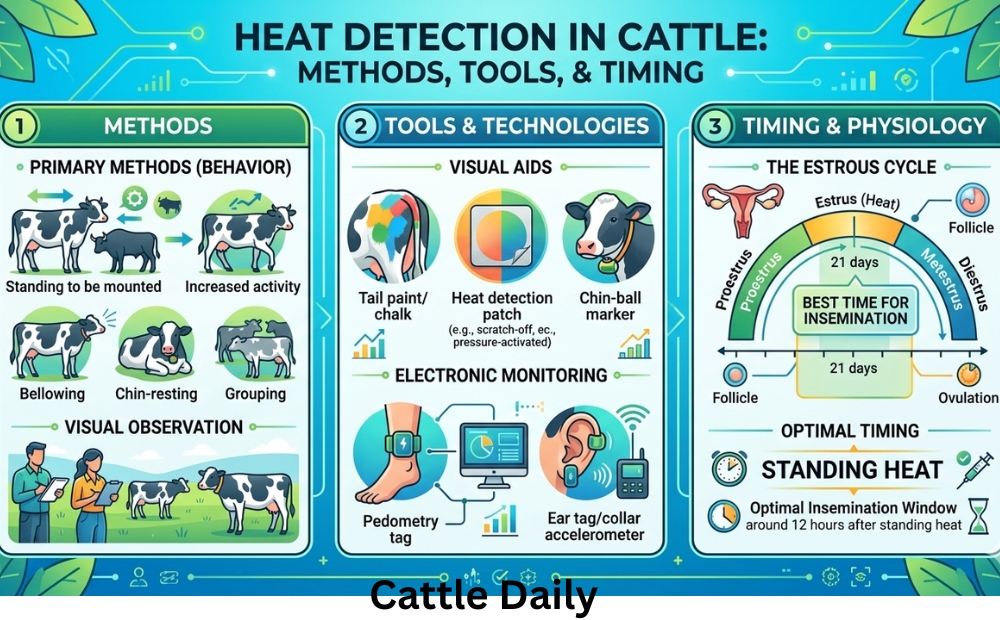
Heat Detection in Cattle: Methods, Tools, and Timing
Your complete guide to estrus detection — from recognizing behavioral signs to leveraging precision technology for maximum AI conception rates.
Accurate heat detection is the single most critical factor in any successful artificial insemination (AI) program, yet industry estimates suggest that 25–50% of heats go undetected in visually managed herds. This guide covers the full spectrum of estrus detection — behavioral signs to recognize, passive and active methods to implement, modern technology tools available today, and the precise timing window that determines whether an AI breeding results in a confirmed pregnancy. Whether you manage 20 cows or 2,000, optimizing heat detection directly drives reproductive efficiency and bottom-line profitability.
1 Why Heat Detection Matters for Your Operation
In cattle reproductive management, heat detection efficiency is the gatekeeper to every other outcome. A conception rate that looks excellent on paper — say, 65% — becomes far less impressive when you realize it only applies to the cows that were correctly identified as being in heat and bred at the right time. Missed heats delay pregnancies, lengthen calving intervals, and directly reduce the number of calves weaned per cow per year.
Each missed heat in a beef operation means a cow goes another 21 days before the next opportunity to breed — and in a seasonal calving system, missing two heats can push a cow outside the desired calving window entirely, converting her to a problem cow or a culling candidate. In dairy operations, prolonged days open translates directly into lost milk revenue and elevated replacement costs. The economics are unambiguous: investing in better heat detection pays for itself rapidly.
University of Missouri extension research estimates that each missed heat in a beef cow-calf operation costs between $35 and $80 in lost calf value when accounting for delayed calving, reduced weaning weights, and potential culling outcomes. In a 200-cow herd with 30% missed heats, that represents $2,100–$4,800 in annual losses from detection failures alone.
2 Understanding the Bovine Estrous Cycle
Effective heat detection begins with understanding what you are looking for and when. The bovine estrous cycle averages 21 days (range: 17–24 days) and is divided into four distinct phases, each with characteristic hormonal profiles and behavioral expressions.
The 21-Day Bovine Estrous Cycle
Days 1–3
~18h
Days 4–7
Days 8–21
Inseminate 12–18 hours after the onset of observed standing heat. Ovulation occurs 28–32 hours after heat onset. Using the AM-PM rule ensures sperm are capacitated and waiting when the egg is released.
3 Signs of Heat in Cattle: Primary and Secondary Indicators
Heat signs are categorized as primary (highly reliable) and secondary (supportive). Observing a combination of signs significantly increases detection accuracy over relying on any single indicator.
Schedule dedicated observation periods of at least 20–30 minutes in the morning (6–8 AM) and again in the late afternoon (4–6 PM) at minimum. Research shows over 70% of mounting activity in beef herds occurs between 6 PM and 6 AM — making early morning observation the most productive single observation period. Adding a 10 PM observation session can dramatically improve weekly detection rates.
4 Heat Detection Methods: Pros, Cons & Accuracy
No single detection method is perfect for every operation. The best approach matches herd size, management system, labor availability, and budget. Below are the six primary methods used in commercial cattle production.
5 Technology Tools for Heat Detection
The last decade has brought a wave of precision livestock technology to heat detection. These tools range from affordable adhesive patches to AI-powered collar systems that integrate with whole-herd management platforms. The right choice depends on herd size, labor availability, and acceptable per-cow cost.
Detection Accuracy Comparison by Method
6 Optimal AI Breeding Timing: The AM-PM Rule
Knowing that a cow is in heat is only half the equation. Breeding at the right time within the estrous period determines whether an egg is fertilized. Ovulation in cattle occurs approximately 28–32 hours after the onset of standing heat, and bovine sperm require 6–12 hours of capacitation in the reproductive tract before they can fertilize an egg.
- Morning heat detection (before 12 PM): Inseminate that afternoon or evening — typically 8–12 hours later.
- Afternoon / evening heat detection (after 12 PM): Inseminate the following morning — approximately 12–18 hours later.
- The target: Live sperm in the oviduct 4–8 hours before ovulation. This aligns perfectly with the AM-PM rule in most cattle.
- Avoid too-early insemination: Breeding more than 24 hours before ovulation results in sperm that have lost viability before the egg is released.
- Avoid too-late insemination: Inseminating more than 6 hours post-ovulation dramatically reduces conception as unfertilized eggs degrade rapidly.
- Synchronization programs (CIDR, OvSynch): Eliminate timing guesswork by triggering predictable ovulation. Fixed-time AI removes the need for heat detection entirely in well-managed programs.
Cows bred too late (more than 18 hours after standing heat ends) show conception rates that can be 20–30% lower than optimally timed breedings. When in doubt — especially with activity monitor alerts — verify heat status with a physical secondary sign check before deciding on insemination time. One false-heat insemination wastes a straw of semen and an AI technician visit.
7 Factors That Suppress Heat Expression
Even the best detection program will underperform if environmental or nutritional factors are suppressing heat expression. Cows can cycle hormonally but show little or no behavioral estrus — a phenomenon sometimes called "silent heat" — when they are stressed, underfed, or physically compromised.
8 Synchronization Programs: Removing the Detection Bottleneck
For operations where labor constraints, large herd size, or poor heat expression make reliable detection difficult, estrus synchronization protocols offer a powerful alternative — or complement — to traditional detection. These hormone-based programs manipulate the estrous cycle to produce predictable, tightly grouped ovulations that allow fixed-time AI (FTAI) without any individual heat detection.
- OvSynch Protocol: GnRH injection on Day 0, PGF₂α on Day 7, second GnRH on Day 9, FTAI 16–24 hours later. Average conception rates: 50–60% in beef cows, 40–50% in dairy.
- CIDR-based programs: Progesterone-releasing intravaginal devices synchronized with GnRH/PGF₂α. Particularly effective in beef heifers and anestrous cows. Adding a CIDR to OvSynch improves conception 5–10% in cycling cows.
- 5-Day CO-Synch + CIDR: A compressed, efficient protocol common in beef operations conducting one large AI event per breeding season.
- Detection + synchronization hybrid: Many operations use synchronization to catch the majority of cows in a timed-AI event, then detect and breed stragglers naturally during the bull turnout period.
Synchronization programs pay the most when semen, technician time, and facility handling costs are shared across a large group of cows processed simultaneously. A 200-cow AI event using FTAI with high-quality bulls can achieve the same 21-day pregnancy distribution as natural service — with the added benefit of knowing the exact breeding date for every animal and the genetic quality of every sire.
9 Full Heat Detection Method Comparison Table
| Method | Detection Rate | Works 24/7? | Labor Required | Cost per Cow/Cycle | Best For | Limitations |
|---|---|---|---|---|---|---|
| Visual Observation | 50–60% | No | High | Labor cost only | Small herds, supplement to other methods | Misses nighttime heats, labor intensive |
| Tail Paint / Chalk | 65–75% | Yes | Low | ~$0.10 | Pasture beef herds, low budget | Cannot confirm standing; weather degrades |
| ESTROTECT Patches | 78–82% | Yes | Low | $1.75–$2.75 | Beef AI programs; moderate herds | Single use; cost adds up in large herds |
| Chin-Ball / Teaser Bull | 72–78% | Yes | Moderate | Bull feed + management | Beef operations with existing bulls | Requires teaser animal; injury risk |
| HeatWatch Transmitters | 85–90% | Yes | Very Low | $4–$6 per event | Feedlots; large dairy & beef herds | Capital cost for receiver system |
| Activity Monitors (leg/neck) | 88–95% | Yes | Very Low | $0.50–$1.50 (amortized) | Large dairy herds; tech-enabled operations | Capital investment; tech dependency |
| Inline Progesterone | 85–92% | Yes | Very Low | AMS subscription | Robotic milking dairy operations | Only for AMS-equipped dairies |
| Fixed-Time AI (FTAI) | ~100%* | N/A | Moderate | $15–$30 (hormones + AI) | All herd types; large seasonal programs | *Requires synchronization protocol; drug cost |
*FTAI achieves 100% breeding exposure through synchronization but conception rates remain subject to individual cow fertility and protocol compliance.
10 Frequently Asked Questions
✓ Key Takeaways
Heat detection is not a peripheral task in cattle reproduction — it is the foundation on which every AI program, synchronization protocol, and genetic improvement plan is built. The difference between a 55% detection rate and a 90% detection rate in a 200-cow herd can translate to 35 additional pregnancies per breeding season — representing tens of thousands of dollars in calf revenue.
- No single method is perfect. Layering two detection approaches — such as tail paint plus pressure patches, or visual observation plus activity monitors — consistently outperforms any single method.
- Timing is everything. Detection accuracy without proper breeding timing loses half its value. Apply the AM-PM rule without exception.
- Environment matters as much as method. Heat stress, poor body condition, and lameness suppress heat expression regardless of detection technology. Fix the cause, not just the detection.
- Technology ROI is real. Activity monitors pay for themselves within 1–2 breeding seasons in herds of 100+ cows through improved conception rates and reduced repeat breeder costs.
- Synchronization is not surrender. FTAI eliminates detection as the bottleneck and allows entire herds to be bred in tightly controlled windows — a legitimate and profitable alternative for many operations.


